Geography Is Law: How The Pitt's Editors Cut a Real-Time ER Without Cheating Space
The Pitt's editor Mark Strand on never entering a room before the character, one-camera POV and sound over score, plus a checklist for real-time edits.
On a show that unfolds in real time, the floor plan works as a continuity system just as much as the clock does. The Pitt's editors cannot cut a doctor to the far end of a corridor they have not walked down, and that one constraint explains most of what makes the show feel true. Anyone cutting a single-location or real-time piece, from a drama to a conference recap, should borrow the rule before the toolset.
Our position: in real-time work, protect space before you protect pace. You can lose almost any line or beat. Once you break the audience's sense of where everyone is, though, the whole conceit falls apart. Here is how the team behind the twice-crowned drama does it, and the rules we take from it.
The show and the people
The Pitt follows one shift in a Pittsburgh emergency department, an hour per episode. At the 78th Primetime Emmys on 14 September 2026 it won Outstanding Drama Series for the second year running, and Noah Wyle took lead actor again, according to Forbes. Mark Strand, ACE, has cut episodes across both seasons on Avid. Most of what follows comes from his Art of the Cut interview with Boris FX (February 2026) and an earlier TheWrap interview (June 2025).
Rule one: the camera never arrives first
Strand says showrunner John Wells "would never want to enter a space before our character, because that point of view is very important to him." That rules out a whole family of standard ER-drama grammar: the establishing shot of the trauma bay before anyone walks in, the cutaway that waits in the room, the drone-style reveal.
The consequence for the edit is blunt. "We have defined the space and we have defined what we're doing," Strand told Boris FX, "so we absolutely cannot jump Robbie down the hall." Instead: "I like to travel with somebody ... we want to move with the person into the next room." Walking time, which most editors cut first, stays in. Strand argues it pays its way, telling TheWrap that "travel time added to the tension".
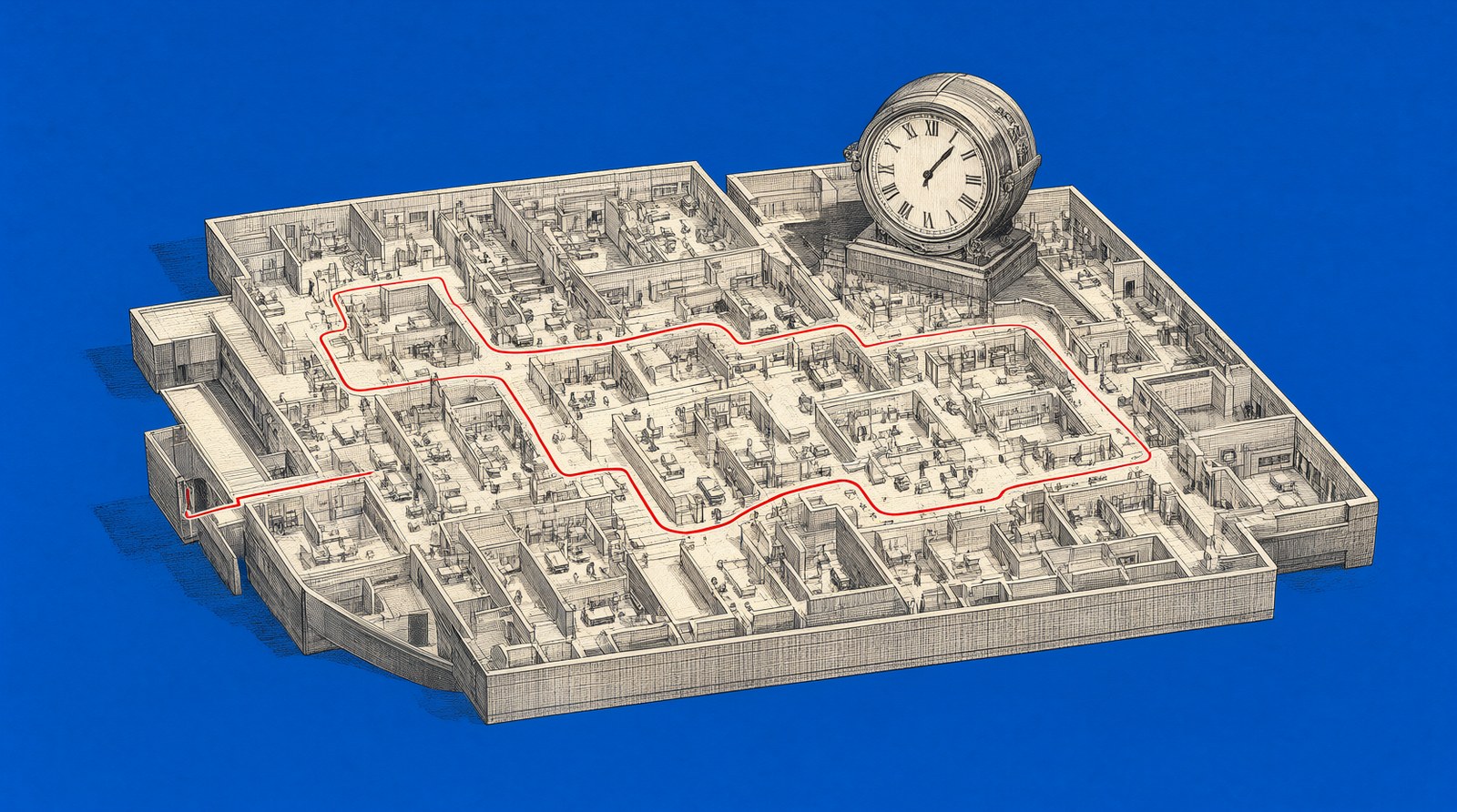
The production backs this up from the start. Production designer Nina Ruscio made a board game "in the style of CLUE" with the floor laid out exactly as built, so every department shares one map.
Rule two: coverage serves one point of view
The show is shot mostly handheld. In traumas there are usually two cameras, but Strand says "the style of our show is not using B camera footage" as a matter of course. The mass-casualty episode used three. TheWrap describes a Z-rig, a Steadicam-style vest and arm that lets the operator change height while following actors on the move.
The editorial choice that follows is unusual. When a scene needs fixing, Strand says, "Where you normally might just do a pickup shot later in a scene, there's so many moving parts here, so it was easier to go all the way back to one." In a continuous space, an insert shot at the wrong moment shows its seams. A full retake does not.
Rule three: sound carries the chaos, not music
Season one's twelfth episode is the mass-casualty hour. By Strand's count "something like 54 patients" come in during the first ten minutes. He cut it by pulling out "what was happening storywise in each individual bed" and rebuilding those threads across the floor. That only works because, as he puts it, sound mixer Von Varga is "really, really good at getting as clean pieces of audio, so you can dig out the behavior on bed one while something's happening in bed two." Overlapping dialogue becomes something you can edit, not a wash you are stuck with.
The original plan was even stricter on music: one piece, the opening track, would be "the only piece of music that was going to be in the whole show." It has loosened since. Strand says the studio asked for "drones, and percussion when a trauma comes in". Even so, the pace on screen comes mostly from production sound and performance, not score.
Rule four: be honest about time, but not pedantic
Real time is a promise, not a stopwatch. "When someone says the time of death, we are close to that minute in the episode, but not meticulous about that," Strand says. Space has to be exact. Time only has to feel right. The length discipline comes from the audience too. His first cut of one episode ran 70 minutes for a slot that airs at around 50, because, he says, viewers are "kind of ready for the show to end around 48, 49 minutes."
The checklist for your own real-time job
You do not need an Emmy budget to use these rules. They apply just as well to a one-room documentary, a product launch recap or a 12-hour event compressed into three minutes:
- Draw the map before you cut. A floor plan with entrances, sightlines and where every camera sat. Pin it next to the monitor. If production did not make one, the assistant makes it from the stills on day one.
- Never arrive before your subject. If the speaker walks from the green room to the stage, either travel with them or cut to an image that clearly marks time passing (a clock, a crowd shot that has filled up). Do not cut straight to them standing at the lectern.
- Keep one primary angle per subject. Use the second camera to rescue a shot, not as part of the style. Constant angle-switching turns a continuous space into a montage.
- Record for separation. Ask for isolated mics on everyone who will talk over each other. In the edit, build overlap from clean tracks, not from a room mic.
- Earn every music cue. Start with none. Add a bed only where production sound genuinely cannot carry the energy, and note why.
- Treat walking time as a budget line. Trim it to the shortest walk that is still believable, not to zero. If a walk is too long to keep, restage the story, not the geography.
- Cut long, then cut to the audience's clock. Our working assumption, drawn from Strand's 70-to-50 ratio, is that a first assembly of a real-time piece will run about 40% over its slot. Plan review rounds around that, not around a lean first cut.
The paradox of The Pitt is that the strictest constraint in the building is what makes it feel loose and alive. Respect the map, and the audience will forgive almost anything else.